|


Our Approach
Sample Timeline


Please
sign
our Guest Book
|
|
The LESS approach to Lean transformation
is a six step process which follows the PDCA cycle. Because
of our commitment to transferability of knowledge and skills, our
application of this approach is always a joint effort involving client
team members and consulting staff working hand-in-hand through each
step. |
|
 |
|
 |
Step
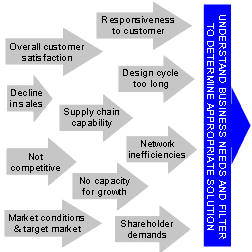
1: Establish the business case for Lean
In most companies, there are often many different business needs
demanding attention at any given time. Lean is obviously not
the only choice available to address these needs and is not the best
immediate choice in some situations. However, many companies
are attempting to implement Lean "because it's the right thing to do"
or "because everyone else is doing it" but without ever really linking
it to their own internal needs. That's why we feel it is very
important to help our clients understand and prioritize their real
business needs and, with this understanding, determine how Lean
Transformation may be applied as a solution. In every case,
we believe that it is necessary to tie the Lean Business System to
immediate needs if the implementation is to succeed.
|
|
|
Step
2: Build the commitment to change
Because Lean is a business system and involves
change at every level across the organization, it is vital that the
client leaders and senior managers understand the scope of the system
and that they show the up-front commitment and continued support
throughout the implementation. In this step we apply
different approaches to achieve this commitment such as senior
management training sessions, model plant tours, participatory
workshops, and other means depending on the current level of
understanding and commitment of the client leadership.
|
|
 |
Step
3: Develop the Lean "Vision" and set the implementation plan
For any change program to be successful, an achievable goal must be
defined up-front and a detailed plan must be laid out to set the
direction. Unfortunately, in many cases the goals and
directions are set without a clear understanding of current conditions.
This often leads to unrealistic goals, poor planning and
execution, and ultimately to the failure of the change program to make
any significant, sustainable impact on the business. We
believe that one of the most important steps in a successful Lean
Transformation is to develop a detailed picture of the current
condition and set targets based on the real information. In
this step, the team members will map and analyze the current value
stream taking into account all relevant operational metrics.
They will then apply the Lean principles, tools, and techniques to
generate a "Vision" of what the ideal production system might look
like, including both the shop floor and all support
functions. By understanding the gap between the ideal and
current systems, the timeframe involved, and any barriers identified
along the way the targets are then set and the detailed implementation
plan is generated which becomes the "roadmap" for all efforts
throughout the Lean transformation.
|
|
|
| Step
4: Communicate the "Vision" and plan
Another often forgotten step that can make all the difference between a
smooth and a rocky implementation is the step of communicating the new
Lean "Vision" and the implementation plan which will be
followed. However, communication alone is not enough to
ensure success. Everyone in the organization not only needs
to hear the ideas and the plan, but also must gain a real understanding
of why this solution was chosen as well as how they will be
affected. This is always best accomplished through active
participation. Having gained the understanding of the
changes, they must also show a level of commitment to help make these
changes successful. Then, implementing the new
system becomes everyone's responsibility.
|
 |
|
|
Step
5: Implement the new Lean System
"The best laid plans..." Unlike many operations consulting
firms, we do not believe design of the system or even implementation
planning are the end deliverables. We are also committed to
fully supporting the implementation of the new system and to help
troubleshoot and "tweak" the system as it becomes operational in order
to realize the highest potential. Implementation often takes
on many forms depending on the situation and will include initial
stabilization activities, physical system element implementation,
support system implementation, supplier activities, and other
Lean tools and techniques which client team members may have learned
about but have never put into practice. That's why we'll be
there for new activities and workshops to make sure the implementation
goes smoothly and the client team members gain the knowledge to
continue these activities on their own.
|
|
 |
Step
6: Standardize the results and begin sustaining efforts
This coincides with the last step in the PDCA cycle which is the Action
step where successful results of the implementation are standardized
across all areas and new plans are generated for those results that did
not meet targets. This is also the time for a review of the
implementation process itself in order to determine what went well and
standardize these processes for the next implementation and what
processes need to be improved. Based on the results from the
previous efforts, the process begins again for the next area, the next
plant, or the supply chain.
|
|
|
|
|


